
Courier and sales channel integrations for furniture brands
Why integration is harder for bulky goods than for parcels, what to ask a 3PL about it, and what a working setup actually looks like.

Every 3PL will tell you they integrate with your sales channels and your couriers. For a small-parcel brand that claim is close to sufficient, because the job is largely solved: orders come down, labels go up, tracking goes back.
For a furniture brand it is not sufficient, because the hard part of your integration is not moving the order — it is deciding what happens to it. A brand shipping cushions, flat-pack side tables, spare brackets, and three-seater sofas from the same warehouse has four different fulfilment routes, and the integration has to know which one each order belongs to. That is where these projects succeed or fail.
What an integration is actually doing
For parcels, all four are close to commodity. For bulky goods, the second and third are where the difficulty concentrates — and the third is where most of the disappointment lives, because a two-person delivery is not a label.
- Orders in. Your sales channel tells the warehouse what to pick, for whom, and where to send it.
- Stock out. The warehouse tells your channels what is available, so you do not sell what you do not have.
- Labels and bookings. The warehouse tells the carrier a consignment exists and gets back a label or a booking.
- Status back. Dispatch, tracking, and delivery outcome flow back to your channel and your customer.
Routing: the part that is actually hard
The defining integration problem for a furniture brand is that your catalogue does not have one fulfilment route. It has several, and the right one is a property of the SKU rather than the order.
A replacement fixing is a parcel. A boxed accessory is a parcel. A flat-pack unit might be a parcel or might be a pallet, depending on its dimensions. A sofa is a two-person delivery. A pergola is a two-person delivery with an installation and possibly a survey first. Those are four different services with four different cost profiles, four different lead times, and four different customer experiences.
So the integration has to carry routing rules, and those rules have to live somewhere reliable. If they live in a person's head, they work until that person is on holiday during peak. If they are attached to the SKU data, they work always. This sounds obvious and it is routinely the thing that has not been done.
Then there is the multi-line order. A customer buys a sofa and two cushions. Does that ship as one consignment, or two — a two-person delivery and a parcel? There is a right answer for your business, but the system has to know it, and it has to tell the customer something coherent about what is arriving when. Splitting silently and letting the customer discover it is how you generate a support ticket for a delivery that worked perfectly.
Multi-channel stock, one warehouse
If you sell on your own site plus Amazon, eBay, and a marketplace or two, your stock file is being read by several systems that do not know about each other. That is fine when you hold a hundred of something. It is a real problem when you hold four.
Bulky-goods brands hold small numbers of expensive things, which makes the classic multi-channel failure — overselling — much more likely and much more expensive. Selling one sofa twice is not a refund and an apology; it is a cancelled order on a marketplace where cancellations affect your account standing, plus a customer who was told they had bought something.
The parts of this worth asking about are unglamorous. How quickly does stock sync after a dispatch, and is that fast enough for your unit counts? Can you hold buffer stock on specific channels, so the last unit is not exposed everywhere at once? What happens to an allocation when an order is placed but not yet picked — is that unit still sellable elsewhere?
There is no universally correct answer. There is only whether the behaviour matches how thin your stock actually is.
Two-person delivery is a booking, not a label
This is the single biggest divergence from parcel fulfilment and the one most likely to be glossed over in a sales conversation.
A parcel dispatch is one-directional and instantaneous. The system creates a label, the item goes on a vehicle, and the customer is told it is coming. Nobody is asked anything.
A two-person delivery is a negotiation. The system proposes a date and time. The customer confirms it, or does not, and the slot has to be reoffered. Access might need checking, and an installation might need a survey before anything can be committed. On the day, the customer is notified when the crew is on the way. On arrival the boxes and the property condition are documented. On completion there are photos and a sign-off.
That is a workflow with a conversation in the middle of it, and it does not fit the shape of a courier integration. Which means it is worth asking directly: when your 3PL says they integrate with two-person delivery services, do they mean bookings, confirmations, notifications, and photo sign-off flowing through the system — or do they mean someone in an office sends an email? Both can work. Only one of them scales into December.
What to ask before you commit
- Which of my specific channels are supported directly, and which need middleware or an API build?
- Where do routing rules live, and can I see and change them without raising a ticket?
- How is a multi-line order handled when one line is a parcel and another needs a crew?
- How fast does stock sync back to my channels after a dispatch, and can I set channel buffers?
- For two-person delivery: what exactly flows through the system — booking, confirmation, pre-arrival, photos, sign-off?
- What happens when an integration fails at 2pm on a Friday in peak? Who notices, and how?
- Is there an API for anything not covered off the shelf, and who scopes it?
- What does the reporting show me about routing — can I see how much of my volume went each way?
How SIMPLEE UK handles it
Our system generates a pick when an order is received and creates a delivery label once it is scanned, with integrations set up per client for their orders and their chosen couriers. Direct integrations cover Shopify, WooCommerce, Magento, Amazon, eBay and many other channels, alongside hundreds of UK and international couriers, pallet networks, and two-person delivery services. Where something is not covered off the shelf, there is an API and we scope it with you.
The two-person side runs as a proper workflow rather than an email chain: booking confirmation with a proposed date, customer confirmation, pre-arrival notification, documentation of boxes and property condition on arrival, and photos and sign-off at completion — delivered under your brand.
All of it surfaces in Team Simplee, the client portal at app.simpleeuk.com: goods in, stock and locations, order status and dispatch, returns, customer service and spares. The point of that is not the dashboard. It is that your team can answer a customer's question without emailing ours.
Getting it right at onboarding
The integration work that causes pain later is almost always the work skipped at the start, and it is almost always the same piece: your product data.
Dimensions, weights, stackability, and the fulfilment route for every SKU are the foundation everything else sits on. If that data is wrong or missing, no integration can compensate — the system will confidently route a sofa to a parcel network because nothing told it otherwise. Cleaning it up is tedious and it is the highest-return work in the project.
Beyond that: test with real orders rather than test data, because your awkward cases are where the value is. Test the exceptions specifically — the multi-line order, the item near a size boundary, the spare part. And do it well before your season, not during it.
If you want to talk through what your channel and courier setup would look like, send us your channels, your carriers, and a rough SKU profile through the get a quote page, or call the team on +44 1787 378154.
Related SIMPLEE UK services
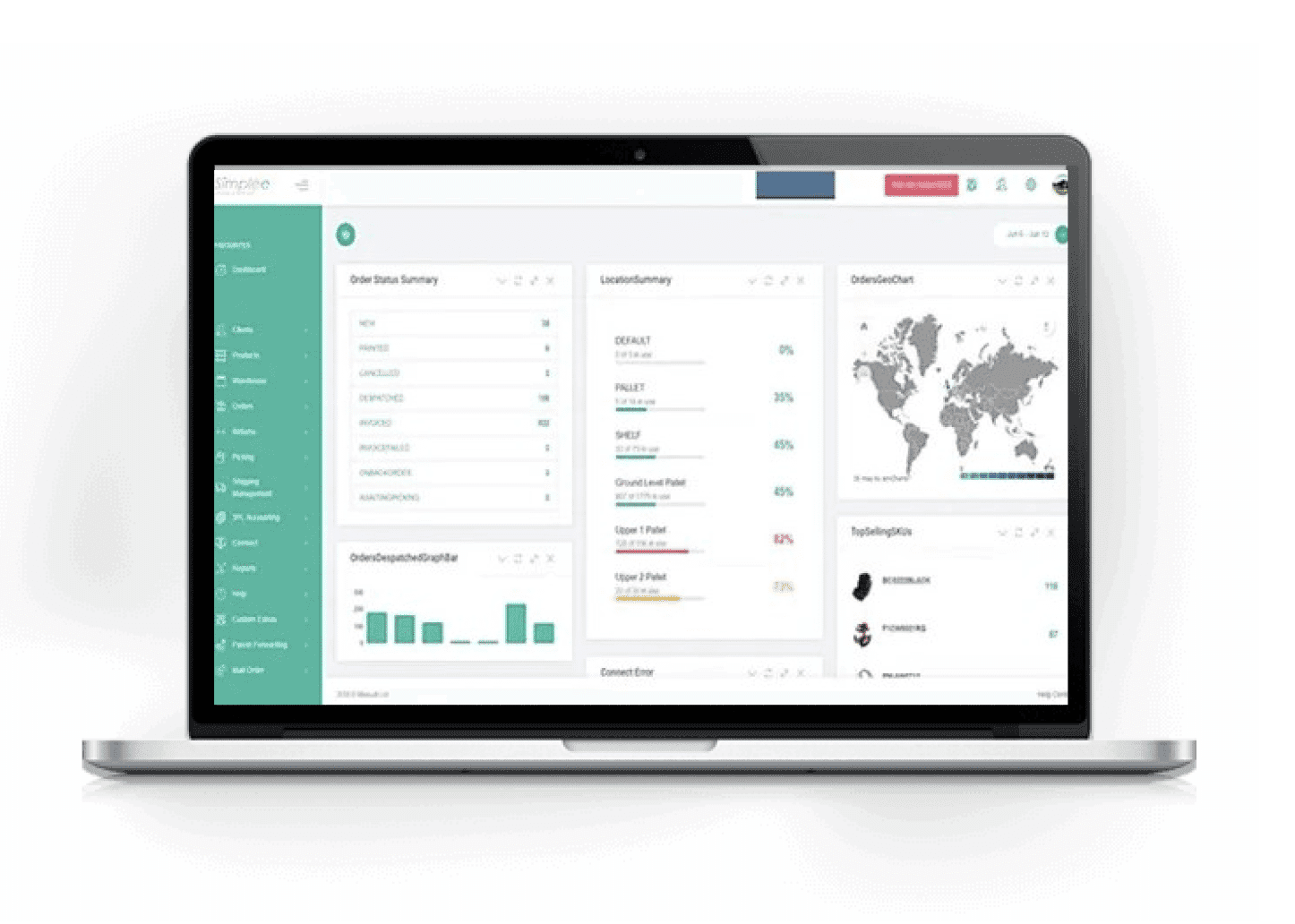
Warehouse technology — stock visibility & reporting
Warehouse visibility, reporting, order status, stock management, and courier integrations through Team Simplee.
- Team Simplee portal access
- Real-time order and stock visibility
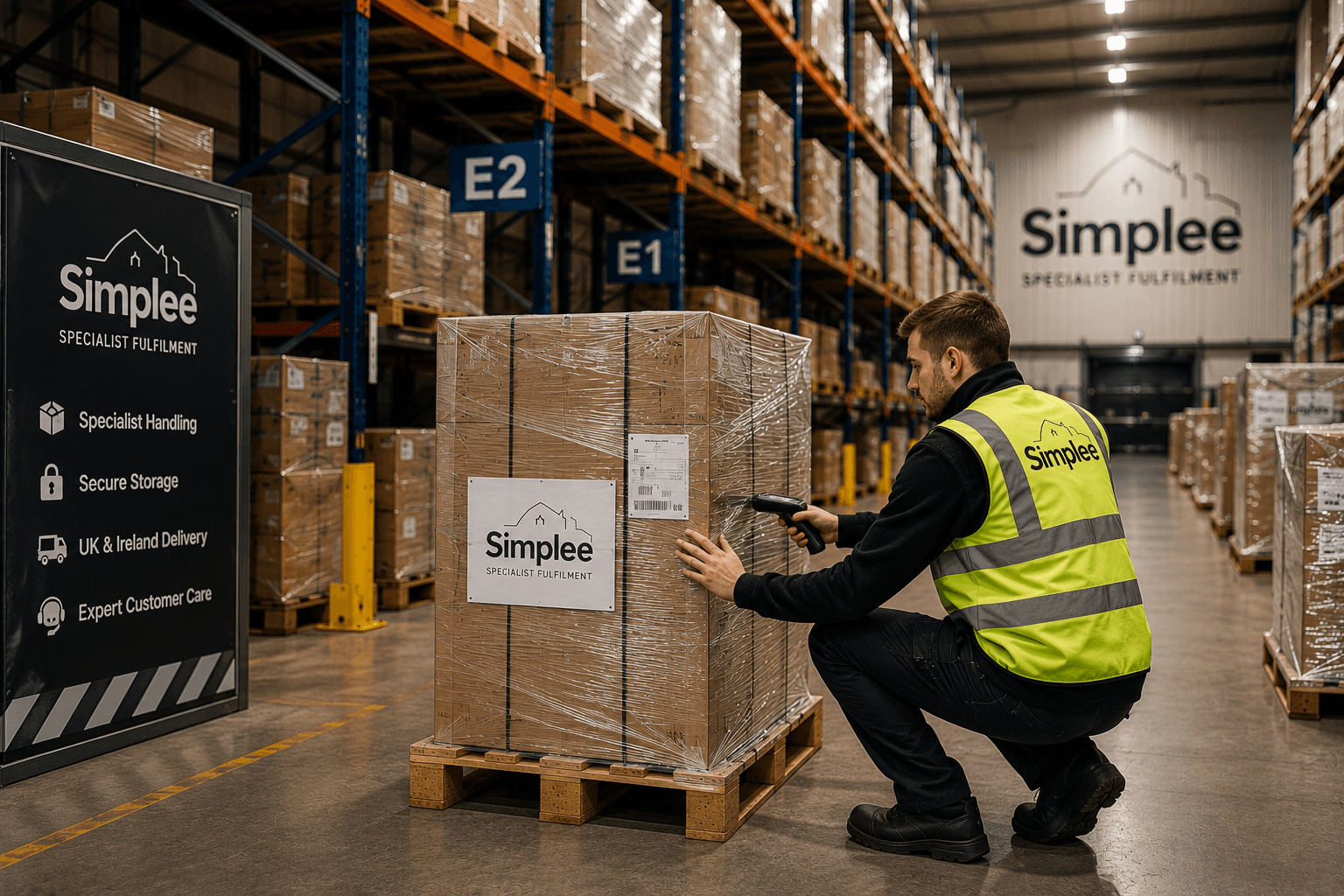
Warehouse fulfilment for bulky & out-of-gauge goods
Inbound shipping, receiving, picking, packing, dispatch, and two-person delivery support for furniture, garden goods, and other awkward stock.
- Inward shipping coordination
- Inventory checks and discrepancy reporting
Indoor furniture e-commerce fulfilment
E-commerce fulfilment designed for indoor furniture ranges, from compact decor to oversized pieces needing white-glove support.
- Storage for mixed furniture SKUs
- Warehouse management system support
Related posts
Stock visibility and reporting: what to expect from a 3PL
Most 3PL stock visibility reporting shows you a number. What you need is a number you can act on, and a record of how it got there.
Read article
Reducing damage rates in indoor furniture fulfilment
Furniture fulfilment damage is rarely one dramatic accident. It accumulates across handling touches. Here is where it actually happens and how to cut it.
Read article