
Storage for awkward goods that do not fit racking
Racking assumes your stock is a neat cube on a standard pallet. When it is not, you need floor storage, stillages, and a warehouse that plans around the product instead of the shelf.
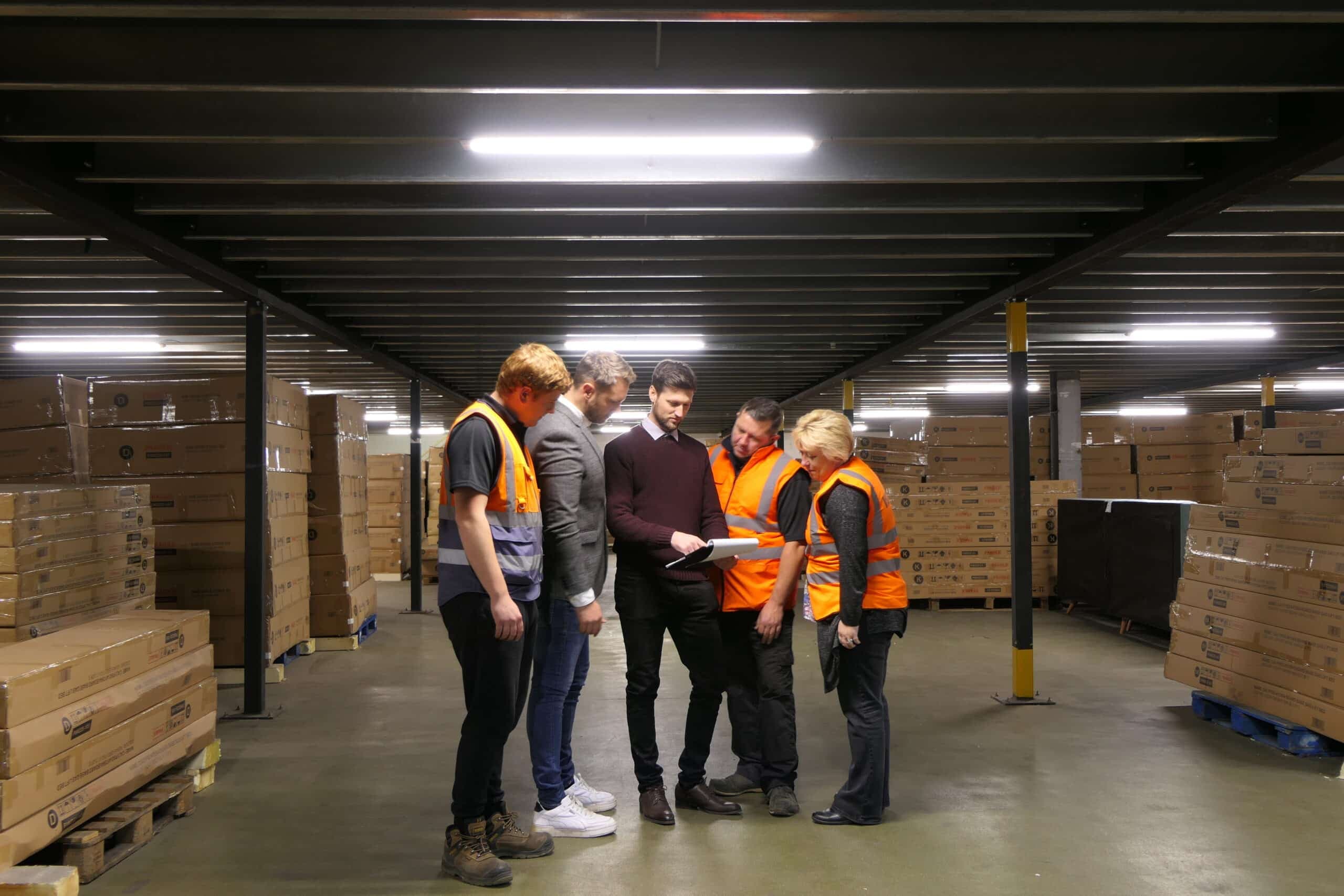
If it does not fit the rack, the rack is the wrong question
Most warehouses are built around one assumption: your stock arrives as a rectangular block on a standard pallet, roughly the same height as every other block, and it stays that way until it is picked. Racking is the physical expression of that assumption. Every beam level, every aisle width, and every forklift in the building is sized for it.
Awkward goods break the assumption. A 4.2 metre pergola beam, a roll of pond liner, a boxed corner sofa, a swim spa, a crate of solar panels, a stillage of steel fixings — none of these are a problem in themselves. They only become a problem when someone tries to force them into a system designed for something else. The answer is not a cleverer racking layout. It is a warehouse that decides how to store each product profile on its own terms.
This post explains what actually goes wrong when awkward stock meets standard racking, what the alternatives are, and what information you need to give a 3PL before anyone can quote you sensibly.
What "awkward" really means in practice
A single SKU can be more than one of these at once. A boxed cantilever parasol is overlong and unstackable. A hot tub is overtall, overheavy, and unstackable. Being specific about which failure applies is what lets an operator choose the right storage method rather than defaulting to "we will put it on the floor somewhere".
- Overlong. The item exceeds the pallet footprint in one direction — beams, poles, rolls, planks, extrusions. Overhang is the enemy of racking because it eats the aisle or fouls the upright.
- Overtall. The item is fine on a pallet but taller than a beam pitch, so it burns two locations to occupy one.
- Overheavy. The item is within footprint but concentrates weight in a way a beam level or a stacked pallet below it should not be asked to carry.
- Unstackable. Not because of weight, but because of shape or fragility. Nothing can go on top of it, so the vertical space above it is dead.
- Unpalletisable. The item does not present a flat, stable base at all. Machinery on skids, part-assembled goods, irregular crates, loose bundles.
What actually goes wrong when awkward stock is forced into racking
The first failure is silent and financial. Overhanging or overtall stock consumes locations it is not paying for. You are billed for one pallet space and physically occupying two, or you have blocked the level above with a product that cannot take a neighbour. Nobody notices until the space audit does not reconcile, and by then the cost has been running for months.
The second failure is handling damage. Getting a long or top-heavy item into a rack location requires the forklift to approach at height, at reach, with limited visibility of the far end of the load. Every extra manoeuvre is another chance for a fork tip to catch a carton corner. Awkward goods do not usually get damaged in storage. They get damaged during the put-away and retrieval that storage forces on them.
The third failure is access. Awkward stock that has been wedged into an unsuitable location tends to become the item nobody wants to pick. It is slower, it needs two people, it might need the aisle cleared. Picking teams route around it. Orders for that SKU quietly take longer than everything else, and the delay is invisible in the reporting because it looks like a normal pick.
The fourth failure is safety, and it is the one that ends the conversation. If a load cannot be placed and retrieved safely at height, it should not be at height. That is not a preference. It is the reason racking has rated capacities and inspection regimes in the first place.
The alternatives to racking
The point of holding all of these options is that you stop having to compromise. A brand with a mixed range often needs three or four of these methods running at once — racked cartons for the small accessories, floor storage for the assembled pieces, stillages for the fixings, out-of-gauge pallets for the frames. That is normal. What it needs is a warehouse where that combination is routine rather than an exception someone has to argue for.
- Floor storage, serviced by aisle. Best for tall, unstackable, or fragile goods. You trade vertical efficiency for zero handling risk at height and fast, single-touch picking.
- Block stacking. Where the product genuinely can carry its own kind, stock is stacked directly and the floor becomes the rack. Efficient for high-volume, uniform, robust SKUs. Poor for anything with a mixed batch or date profile, because you can only reach the front.
- Stillages and cages. Metal frames that give an irregular product a stable, stackable outer form it does not have on its own. Turns an unpalletisable item into a handleable unit.
- Out-of-gauge pallets. Bespoke oversized bases built to the dimensions of the item, so that an overlong product gets a base that actually supports it instead of an overhang.
- Outdoor storage. For genuinely weather-tolerant stock, or for overflow during a peak, moving robust goods outside frees internal space for the stock that needs it.
The information a 3PL needs before they can help
That last point matters more than people expect. Storage method and turnover are linked. A product that ships every day needs to be reachable in one movement even if that costs floor space. A product that sits for five months can be stored densely, because you will only pay the retrieval cost once.
- Boxed dimensions per SKU, not product dimensions. The carton is what we store, not the sofa inside it.
- Boxed weight, and whether the weight is centred or concentrated at one end.
- Whether the item can be stacked, and if so, how many high, and on what.
- Whether it can be stored on its side or must stay one way up.
- How it arrives — loose in a container, on supplier pallets, in crates, on skids.
- Expected turnover per SKU. A slow-moving, unstackable item is a very different storage problem from a fast-moving one.
- Whether the range is seasonal, and roughly when the inbound and outbound peaks land.
Why the same stock costs different amounts in different warehouses
When brands compare 3PL quotes for awkward stock and see wide variation, the usual cause is not margin. It is that the operators are pricing different physical realities. A warehouse that will only rack your goods has to price the space your overhang wastes. A warehouse with floor space, stillages, and out-of-gauge pallet capability can price the space your goods actually occupy.
This is also why a per-pallet rate can be misleading for a bulky range. If half your SKUs do not fit a pallet, a pallet rate is a proxy for something that is not happening. Ask instead how the operator intends to store each product profile, and what unit they will bill it in. A clear answer to that question tells you more about whether they have handled goods like yours than any amount of general reassurance.
How SIMPLEE UK approaches it
We were set up for this. SIMPLEE UK has operated from Sudbury in Suffolk since 2017, with around 120,000 sq ft of capacity, and the mix of storage methods described above is our normal working pattern rather than a special case. We are a UKWA-accredited member, and stock is segregated by client with clear identification and inventory records.
In practice that means our specialist internal storage service covers the things that defeat standard 3PLs — rolls of flooring, pond liners, tonne bags, solar panels, event equipment, white goods, commercial fittings, and the large boxed furniture and garden goods we handle every day. Where a product genuinely does not fit a pallet, we build the storage around the product. Where it does, we rack it, because that is cheaper for you and there is no reason to make it complicated.
Deciding what to do next
If you are currently paying for racked space and quietly working around stock that does not suit it, the honest test is simple: walk your storage and count the locations that are half-empty because of an overhang, a height, or an item nothing can stack on. That number is your storage inefficiency, and it will not improve on its own.
The next step is not a contract. It is a conversation with your SKU list and your boxed dimensions in front of you, so someone can tell you which of your products should be racked, which should be floored, which needs a stillage, and which needs an out-of-gauge base. You can call us on +44 1787 378154 or email sales@simpleeuk.com if you want to have that conversation with your numbers in hand.
Related SIMPLEE UK services
Specialist internal storage for awkward goods
Internal storage for awkward, bulky, fragile, and specialist materials that need careful handling beyond pallet or rack.
- Specialist internal storage
- Floor storage for awkward goods
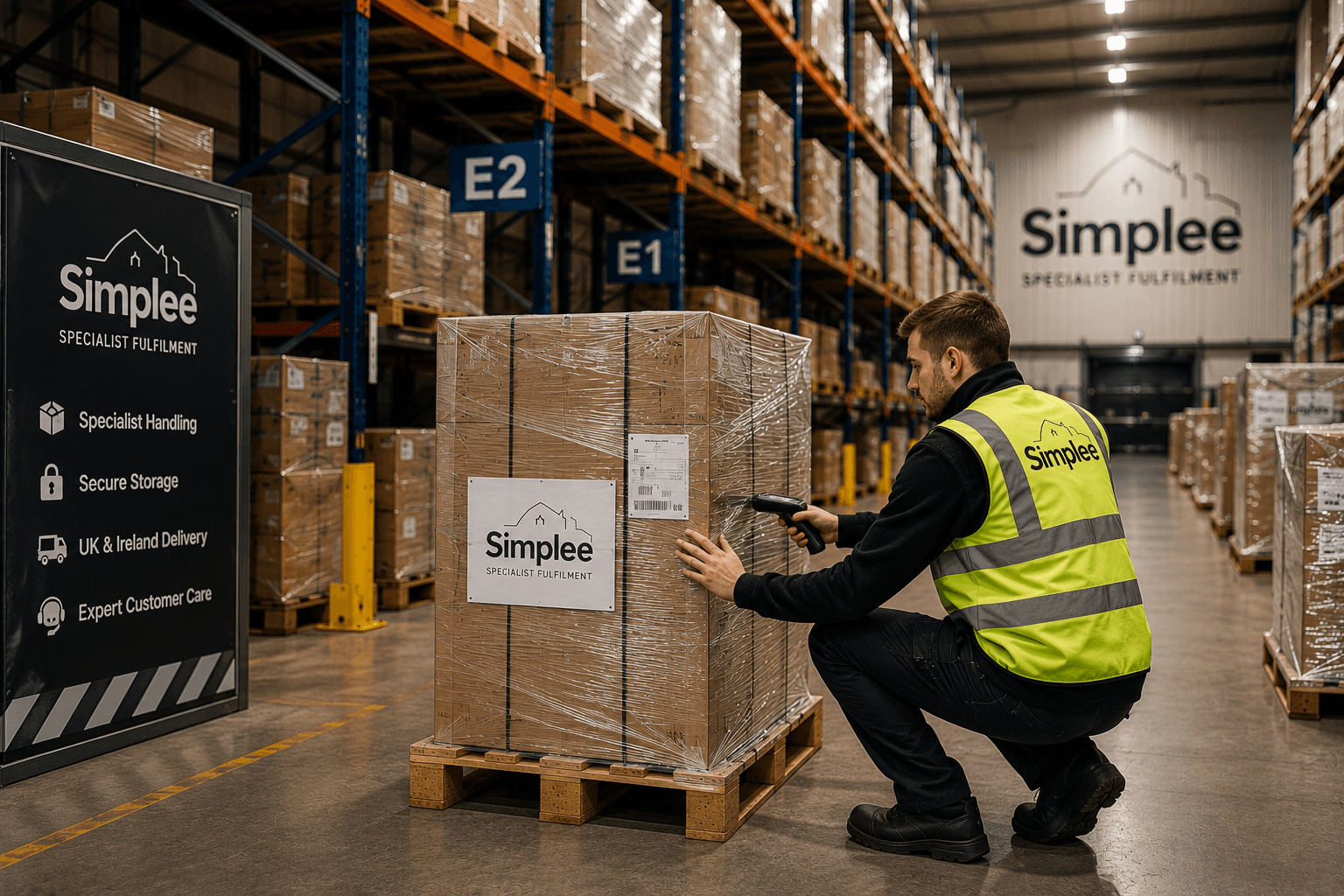
Warehouse fulfilment for bulky & out-of-gauge goods
Inbound shipping, receiving, picking, packing, dispatch, and two-person delivery support for furniture, garden goods, and other awkward stock.
- Inward shipping coordination
- Inventory checks and discrepancy reporting
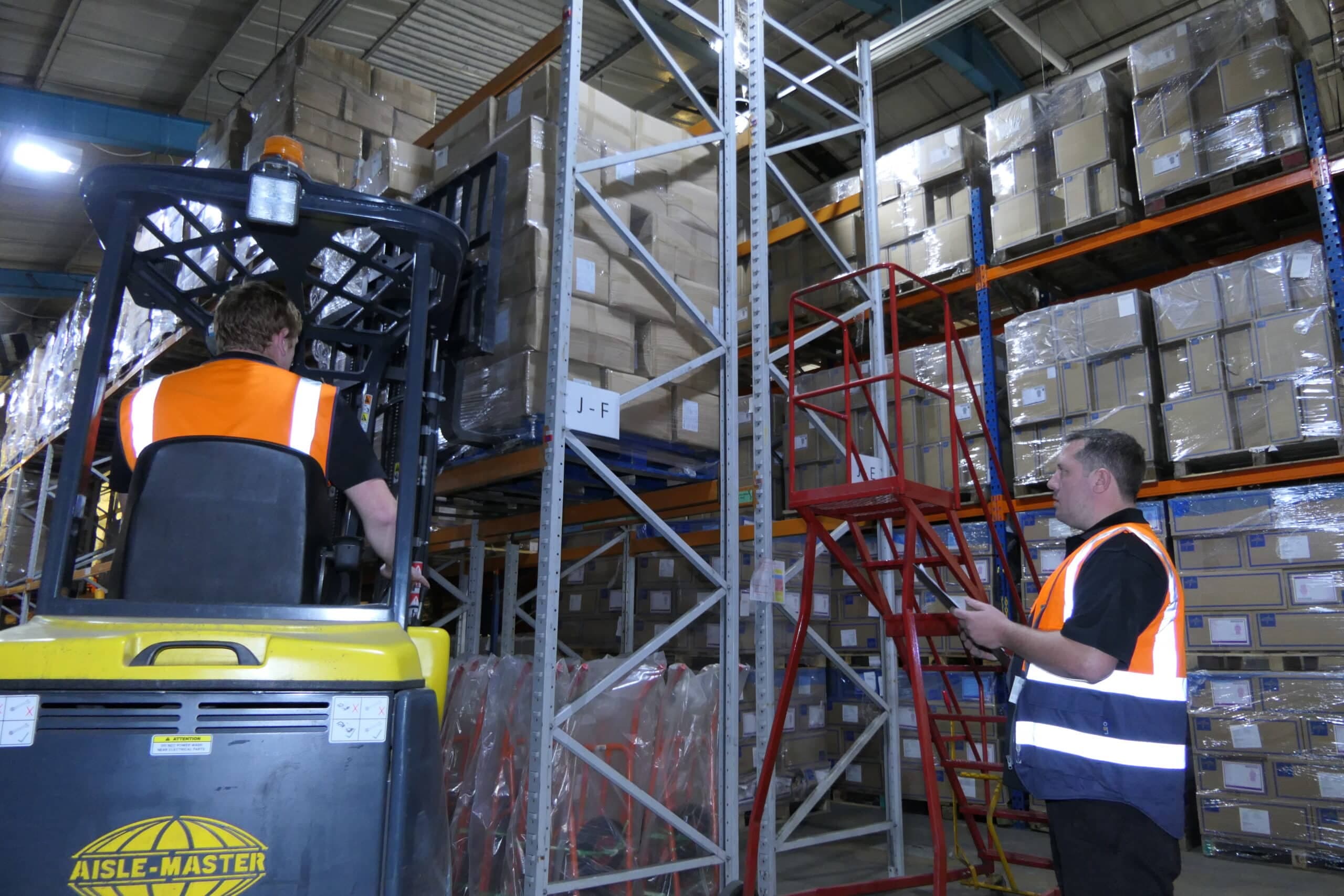
Pallet storage & out-of-gauge pallet solutions
Pallet storage for standard, oversize, stackable, racked, and outdoor stock profiles.
- Out-of-gauge pallet solutions
- Outdoor and racked storage options
Related posts
Out of gauge pallet storage explained
What happens when your stock overhangs the pallet — bespoke oversized pallets, racked versus floor decisions, and how out-of-gauge storage is actually priced.
Read article
Racked, stacked or floor: choosing the right pallet storage option
Racking, floor stacking, floor-serviced storage and outdoor space each suit different stock. How to work out which of your pallets belongs where.
Read article