
Packaging standards for flat-pack and assembled furniture
What good furniture packaging actually specifies — board grade, corner protection, carton marking, and how flat-pack and assembled goods need completely different answers.

Your packaging spec is written at the factory, not the warehouse
By the time a boxed wardrobe reaches a fulfilment warehouse, its packaging is already decided. We can add protection, we can repack, we can pick more carefully — but we cannot retrofit a board grade or move a fixings bag that was placed against a polished panel three months ago in a factory. The decisions that determine whether your furniture survives the journey were made at specification time.
This post is about those decisions. It is not about handling technique or damage reduction in the warehouse, which is a separate subject. It is about what you should be writing into your packaging specification before your manufacturer builds the first carton.
Flat-pack and assembled are different problems
The single most common packaging mistake is treating these as variations of the same thing. They are not. They fail in opposite ways and need opposite solutions.
Flat-pack furniture is dense, heavy, and geometrically simple. The panels themselves are strong in the plane of the board and weak at the edges and corners. The carton is not really protecting the product from crushing — the stack of panels can carry a lot of load. The carton is protecting the edges, keeping the panels from moving against each other, and stopping loose hardware from scratching finished faces. Flat-pack failures are edge damage, corner crush, surface scratching from internal movement, and split cartons where the weight has torn through at a handling point.
Assembled furniture is the inverse. It is light for its volume, structurally awkward, and full of voids. Nothing about the product resists compression. The carton and its internal supports are doing all of the protective work, and the vulnerable points are protrusions — legs, arms, feet, handles, backs. Assembled failures are snapped legs, crushed corners where the void behind the panel gave way, fabric rubbing, and damage from stacking something on a carton that was never able to carry it.
A packaging spec that does not distinguish between these two is going to be wrong for at least one of them.
Materials: what to actually specify
Two of these deserve emphasis because they are the ones most often left out. First, fixings. A bag of bolts loose in a carton with a lacquered panel will find the panel. Every time. Second, void fill placement. Protection that is not fixed in position migrates during transit and ends up in the bottom of the box, leaving the item unsupported for the second half of its journey.
- Board construction. Single wall, double wall, or triple wall — and say which. Heavy flat-pack panels and large assembled goods should not be arriving in single wall.
- Board performance. Ask your manufacturer to state the edge crush and bursting values they are supplying against, and get it in the spec rather than the sales conversation.
- Edge and corner protection. Moulded corner blocks, edge profiles, or angle board. For flat-pack this is the primary protection, not a nice-to-have.
- Internal void fill and location. Foam end caps, moulded inserts, or fitted blocks that hold the product still. Loose fill in a large void does very little.
- Surface protection. A protective film or interleaving layer between finished faces and anything that can rub them.
- Fixings containment. Hardware in a sealed bag, retained in its own compartment, positioned away from finished surfaces.
- Closure. Tape width, tape count, and pattern. A heavy carton closed with a single strip of thin tape will open at exactly the moment it should not.
- Palletisation and wrap. How units are to be stacked on the supplier pallet, whether they need interleaving boards, and how the load is to be wrapped and secured.
Design the carton for the whole journey, not the container
Furniture packaging is often specified for the sea leg and nothing else. That is a reasonable instinct if your only historical failure mode was a container arriving badly. It is inadequate for a direct-to-consumer range.
The journey your carton has to survive is longer than the container. It has to be devanned, checked, put away, stored — possibly for months, possibly with something above it — retrieved, picked, handed to a carrier or a two-person crew, moved through the customer's doorway, and quite often carried up a staircase and around a turn. Every one of those stages applies a different force.
Storage in particular is underrated. A carton that survives shipping perfectly well can fail slowly under sustained compression in a stack, especially if humidity has softened the board. If your range is seasonal and sits in storage over the quiet months, your board needs to be specified for months of load, not days of transit.
The handover to the customer matters too. If a carton has no defined lifting points, two people will improvise, and improvised lifting on a large box means fingers punching through the side panel. A carton with proper hand holes in reinforced positions gets carried the way you intended.
Labelling and carton marking
Multi-carton sets are the single largest avoidable source of pain in furniture fulfilment. If box 3 of 3 is not visibly linked to boxes 1 and 2, then somewhere in the chain — at goods-in, at pick, at delivery, or in the customer's hallway — they will be separated. The fix is trivial and belongs on the carton artwork.
- A scannable SKU barcode on at least two adjacent faces. One barcode on one face means someone has to turn a large, heavy carton to read it.
- Human-readable SKU, product name, and colour or finish in large type. Picking teams read words at speed under bad light before they scan.
- Multi-carton identification: "Box 2 of 3" prominently, plus a shared parent reference so the set can be reconciled. A furniture set split across cartons with no linkage is a returns case waiting to happen.
- Orientation and stacking marks that mean something. "This way up" and a stated maximum stack height, marked clearly, not a generic printed symbol nobody has verified.
- Weight on the carton. This drives the handling decision — one person, two people, or mechanical.
- Fragility marking only where it is true. Marking everything fragile means nothing is fragile.
What to put in the manufacturer brief
Turn all of this into a written packaging specification that forms part of your supply agreement rather than a set of preferences discussed on a call. It should name the board construction and performance values, the corner and edge protection, the internal support method and its fixing, the surface protection, the fixings containment, the closure method, the carton marking artwork including barcode placement, and the palletisation and wrap standard.
Then verify it. Ask for a packed sample of the actual production carton, not a prototype, and open it here in the UK before the first full container ships. A packaging spec that has never been checked against a real production unit is a document, not a control.
Finally, build in a change rule. If your manufacturer changes board supplier, insert design, or carton size, that is a change you need to know about, because your storage method, your carrier rate, and your damage profile all depend on it. Silent packaging changes are a real thing and they usually surface as an unexplained spike in claims.
How your 3PL should feed back into the spec
Your fulfilment partner sees more of your packaging performance than you do. We open cartons at goods-in, we watch how they behave in storage, we pack them for dispatch, and through our returns and customer service workflows we see what comes back and why.
That is a feedback loop worth using. At SIMPLEE UK we photo-document returns and report back to the brand, which over a season tells you something a supplier audit never will: which SKU fails, at which point, on which face. If the same corner keeps arriving crushed, that is not bad luck. That is a corner protection specification that does not work, and it is fixable at the factory for a few pence a unit.
Where a product genuinely needs more than it arrived with, we can add protective packaging on dispatch. That is a sensible fix for a specific SKU, but it should be a considered decision, not a permanent subsidy for a packaging spec that was written too thin.
Where to start
If you have a range in market and no written packaging specification, start with your worst SKU rather than your whole catalogue. Take the product with the highest damage or complaint rate, work out exactly which of the failure modes above is happening, and fix that one properly. The lesson usually generalises across the range.
If you are launching a range and the packaging is not yet locked, this is the cheapest moment you will ever get to specify it correctly. Getting a packed production sample opened and assessed in the UK before the first container ships costs almost nothing compared with a season of avoidable replacements.
We handle indoor and garden furniture every day and we are happy to look at a sample carton and tell you plainly what we think will happen to it. Call +44 1787 378154 or email sales@simpleeuk.com.
Related SIMPLEE UK services

Indoor furniture e-commerce fulfilment
E-commerce fulfilment designed for indoor furniture ranges, from compact decor to oversized pieces needing white-glove support.
- Storage for mixed furniture SKUs
- Warehouse management system support
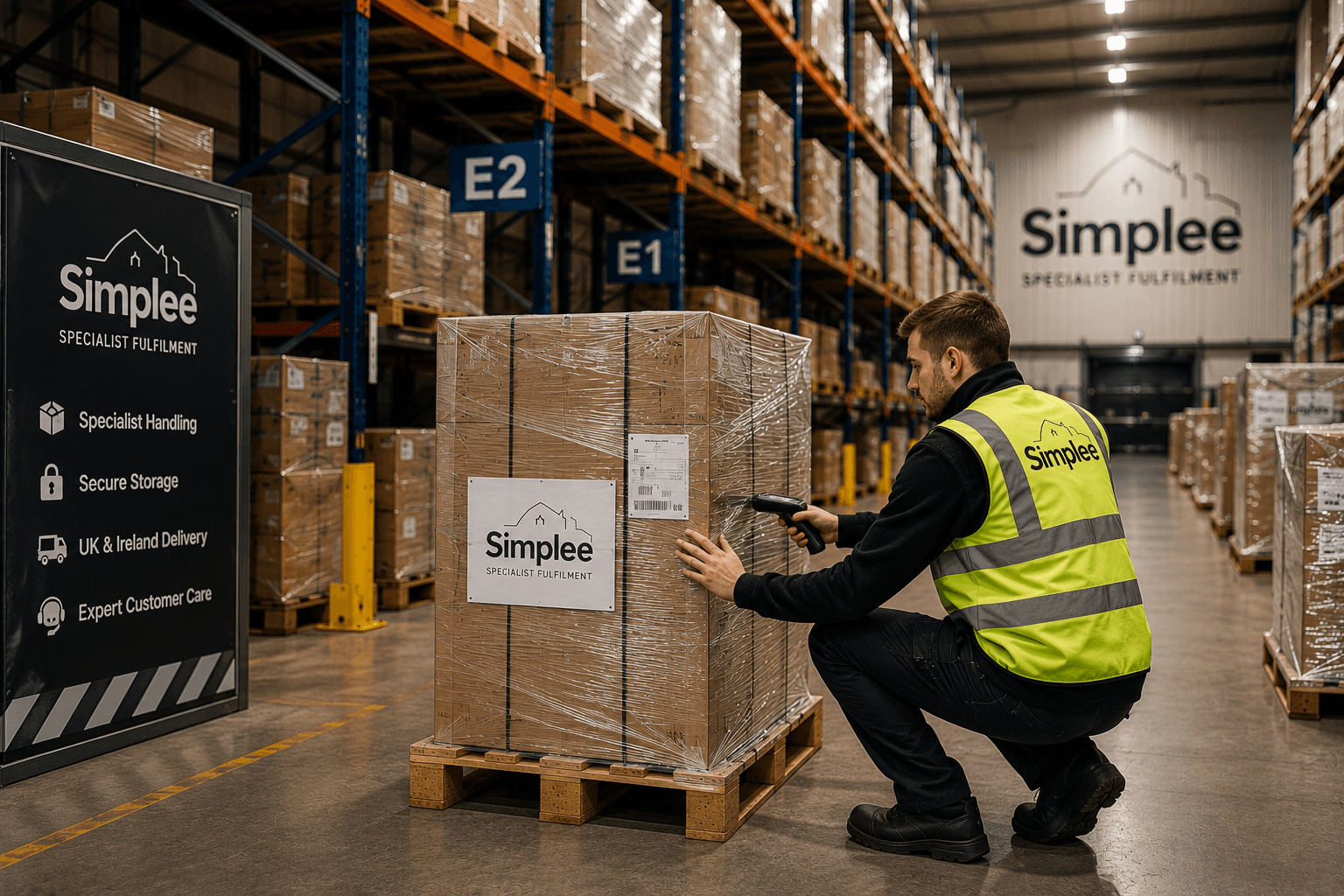
Warehouse fulfilment for bulky & out-of-gauge goods
Inbound shipping, receiving, picking, packing, dispatch, and two-person delivery support for furniture, garden goods, and other awkward stock.
- Inward shipping coordination
- Inventory checks and discrepancy reporting

Outsourced customer service for e-commerce brands
Outsourced customer care combining personal UK-based support with software-driven query handling and fulfilment visibility.
- Telephone customer support
- Query tracking and KPI reporting
Related posts
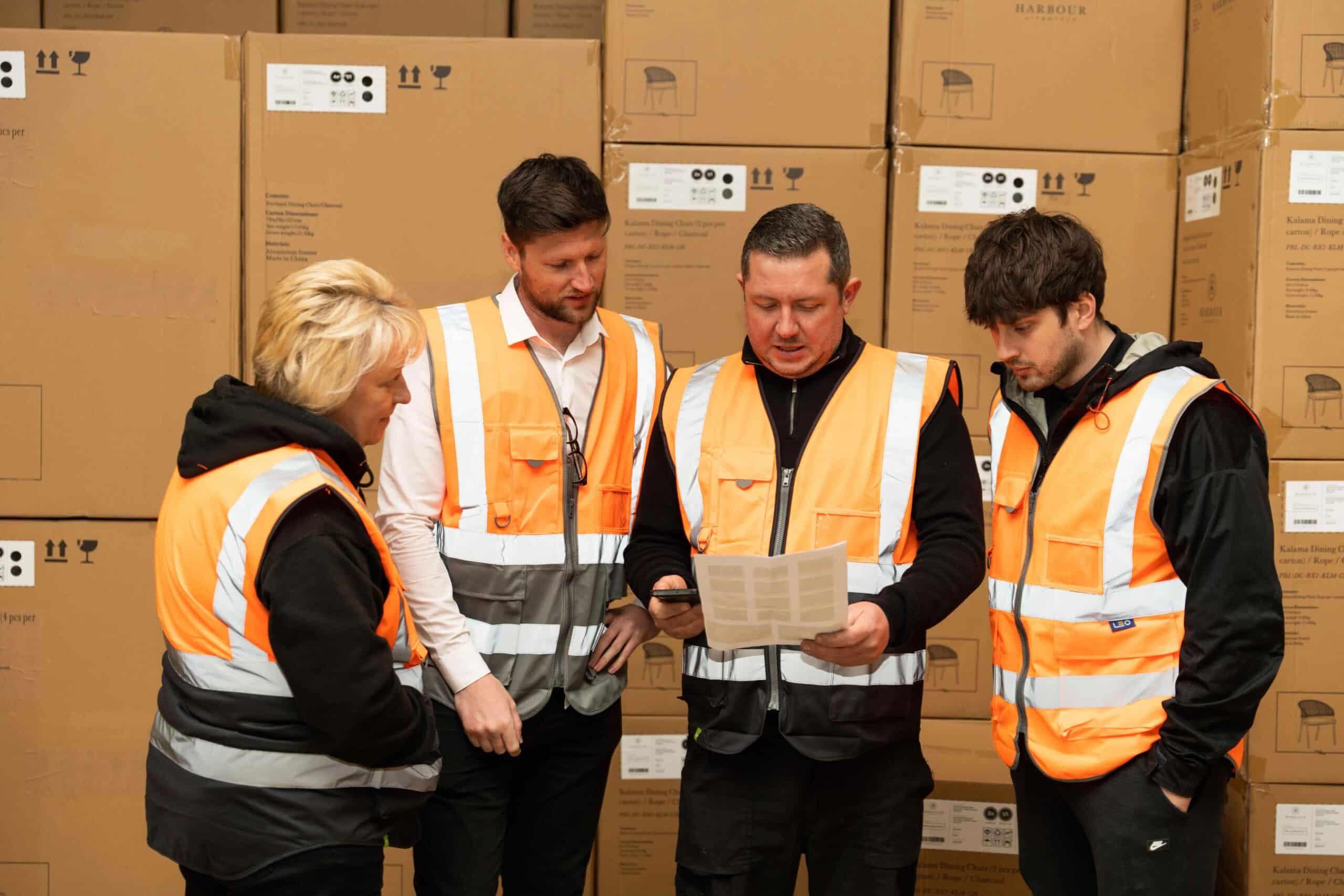
Reducing damage rates in indoor furniture fulfilment
Furniture fulfilment damage is rarely one dramatic accident. It accumulates across handling touches. Here is where it actually happens and how to cut it.
Read articleReturns handling for oversized goods
Oversized returns are not big parcel returns. Why collection, inspection, and the resell decision drive the whole cost — and how to build a process that recovers value.
Read article